By Rob Edwards
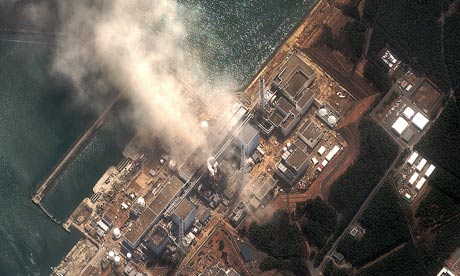
Internal emails seen by Guardian show PR campaign was launched to protect UK nuclear plans after tsunami in Japan
Government
officials launched a PR campaign to ensure the accident at the
Fukushima nuclear facility in Japan did not derail plans for new
nuclear power stations in the UK. Photograph: AP
British
government officials approached nuclear companies to draw up a
co-ordinated public relations strategy to play down the Fukushima
nuclear accident just two days after the earthquake and tsunami in
Japan and before the extent of the radiation leak was known.
Internal emails seen by the Guardian show how the business and
energy departments worked closely behind the scenes with the multinational companies
EDF Energy,
Areva and
Westinghouse to try to ensure the accident did not derail their plans for a new generation of nuclear stations in the UK.
“This has the potential to set the nuclear industry back globally,” wrote one official at the
Department for Business, Innovation and Skills (BIS),
whose name has been redacted. “We need to ensure the anti-nuclear
chaps and chapesses do not gain ground on this. We need to occupy the
territory and hold it. We really need to show the safety of nuclear.”
Officials stressed the importance of preventing the incident from undermining public support for
nuclear power.
The Conservative MP Zac Goldsmith,
who sits on the Commons environmental audit committee, condemned the
extent of co-ordination between the government and nuclear companies
that the emails appear to reveal.
“The government has no business
doing PR for the industry and it would be appalling if its departments
have played down the impact of Fukushima,” he said.
Louise Hutchins, a spokeswoman for Greenpeace, said the emails looked
like “scandalous collusion”. “This highlights the government’s blind
obsession with nuclear power and shows neither they, nor the industry,
can be trusted when it comes to nuclear,” she said.
The Fukushima accident, triggered by the
Japan earthquake and tsunami on 11 March, has forced 80,000 people from their homes. Opinion polls suggest it has
dented public support for nuclear power in Britain
and around the world, with the governments of
Germany,
Italy, Switzerland, Thailand and Malaysia cancelling planned nuclear power stations in the wake of the accident.

